Sons of Ham, Introduction
The Question That Keeps Coming Back
On March 21, 1861, a crowd gathered at the Athenaeum in Savannah, Georgia, to hear the new vice president of the Confederacy. His name was Alexander H. Stephens. He spoke without a written text. A newspaper reporter took down what he said, and a year later the report was reprinted in a collection of documents from the war.
If you heard about the curse of Ham from a pulpit or a parent, the idea was already old when Stephens stood up that day. He did not need to explain it to his audience. He only needed to mention it.
A speech in Savannah
Stephens told the crowd that the old Union had rested on a mistake. Its founders, he said, had assumed that the races were equal, and that assumption was an error. The new government in the South rested on the opposite idea. In his words, that idea was its corner-stone.
Then he described the society he wanted to protect. The reporter recorded these sentences:
“With us, all of the white race, however high or low, rich or poor, are equal in the eye of the law. Not so with the negro. Subordination is his place. He, by nature, or by the curse against Canaan, is fitted for that condition which he occupies in our system.”
Stephens did not stop to quote Genesis. He did not name a chapter or a verse. By 1861 he did not have to. In America the curse had become the most common religious argument for slavery, and it had been preached for generations.
The argument behind that phrase was short, and the audience knew it by heart. Africans are the children of Ham. Noah cursed Ham’s line. So slavery is the will of God. Preachers repeated those three steps in the South, and some repeated them in the North as well.
The speech gave two reasons for slavery in a single breath. The first was nature. The second was a curse spoken in the Bible. This book is about the second reason, and about one word in that sentence.
Keep that word in mind. Canaan.
Keep reading the introduction
Where everyone agrees
This book grew out of a video about the sons of Ham. Under it, readers left more than a hundred comments. Many of them disagreed with each other about Egypt, about Israel, about who the first people were. The comments that drew the most agreement said something simpler. Black people come from the Creator, and they were made in the image of God.
Genesis says the same thing on its first page:
“So God created man in his own image, in the image of God created he him; male and female created he them.” (Genesis 1:27)
Every reader of this book can stand on that verse, whatever they believe about Ham. It comes eight chapters before Noah’s tent. It speaks of all people at once, and it gives no exceptions.
That is the starting point. The argument about Ham is real, and the next chapters take it apart line by line. It is an argument about one family inside the human family. Genesis settles the larger question before that family is even born.
Seven names
In Genesis 10, the Bible lists the families that came from Noah’s three sons. One verse gives the sons of Ham:
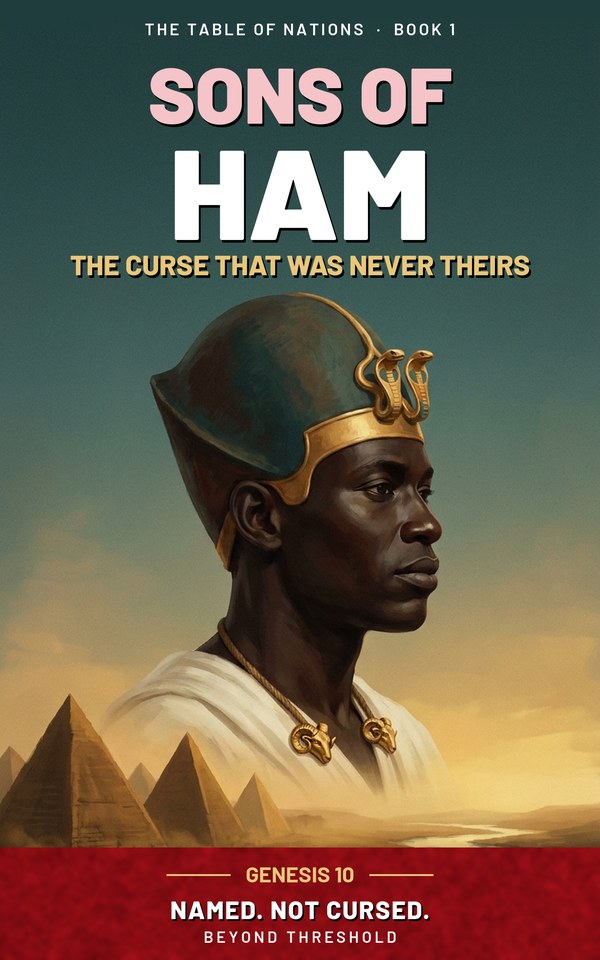
“And the sons of Ham; Cush, and Mizraim, and Phut, and Canaan.” (Genesis 10:6)
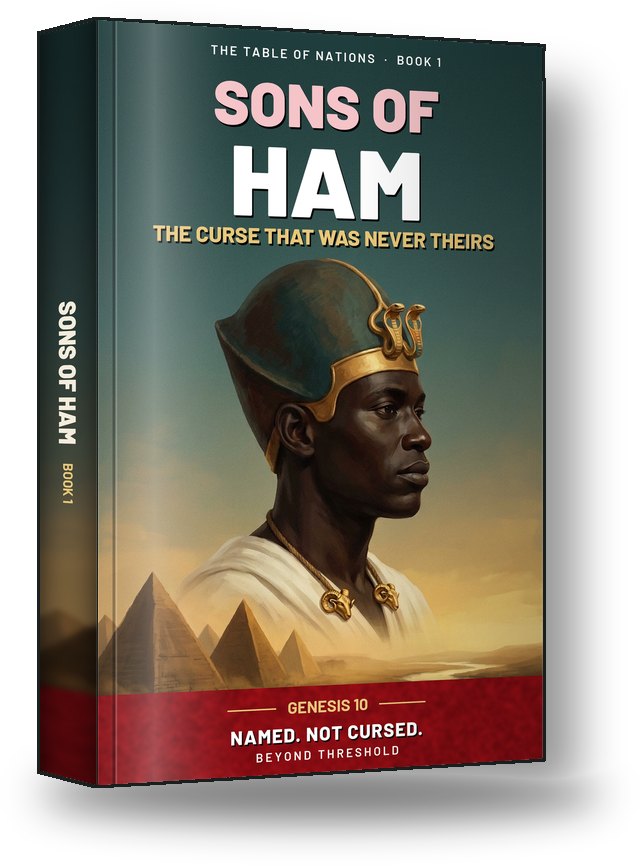
Four names. Three of them point to Africa. Cush is the land along the upper Nile, south of Egypt. Mizraim is the Hebrew name for Egypt itself. Phut, by the oldest explanations, is Libya on the northern coast.
The fourth name points somewhere else. Canaan’s land, as Genesis draws it, runs along the eastern coast of the Mediterranean, from Sidon in Lebanon down to Gaza.
This book follows seven names. Three of them are Ham’s African sons. Three more are people who carried those lines into the later pages of the Bible. One is a king of Cush named in the Second Book of Kings. One is a palace official from Cush who pulled a prophet out of a pit. One is a royal title, the title of the queen whose treasurer met Philip on the road to Gaza.
Six of the seven belong to Africa. The seventh is Ham’s fourth son, and his is the only name in the curse.
The book is built in three parts. Part 1 shows how to read the two chapters at the center of the argument. Chapter 1 looks at Genesis 10 as a document. Chapter 2 reads the scene in Noah’s tent slowly. Chapter 3 follows the misreading from ancient commentaries to American pulpits, and it also meets the people who answered it at the time.
Part 2 gives each of the seven names a chapter of its own. Part 3 turns to other answers that readers bring to these names. Some say Black Americans descend from Judah, not Ham. Some say the first people on earth were Black. Those answers are tested by the same three witnesses, with the same respect.
The chapters count the names down, from number seven to number one. Number seven is Egypt. Number one is Canaan, the name Stephens spoke in Savannah.
Three witnesses
Each name in this book is tested by three witnesses.
The first witness is the text. That means what the Bible actually says, quoted from the King James Version and read slowly, word by word. Who is named in a verse? How many times? Who is missing?
The second witness is the land. That means history and archaeology: what kings carved in stone, what scribes wrote on clay, what came out of the ground.
The third witness is DNA. In the last twenty years, scientists have read the genomes of people who lived thousands of years ago in Egypt, Libya, Sudan and Lebanon. Their results can be compared with the places Genesis names.
Sometimes the witnesses agree. The Second Book of Kings names a king of Cush who came out against the Assyrian army. The Assyrian king’s own clay records put an army from Cush on the same road. In Sudan, the same king’s pyramid still stands. Here the text and the land tell one story.
Sometimes they do not agree, and the chapter says so. Sometimes a witness is missing. No ancient genome has yet been published from Cush in the age of its pyramids. The chapter on Cush says so plainly and leaves the gap open.
Some readers will say that the Bible is not a history book. This book does not ask them to accept that it is. It asks them to read what Genesis says, then compare it with what the ground and the genome say. Checking the facts requires no faith. It requires a Bible, the sources in the notes, and some patience.
Not every claim in these pages stands on the same ground. So each chapter ends with a short section called What we can say. It has three lines, always in the same order:
Confirmed is what the text or the evidence shows directly.
Tradition is what rests on an old reading, a later book, or a teacher’s explanation. Many of these traditions are ancient and worth knowing. They are still readings.
Still open is what scholars still argue over, or what no one yet knows.
The three lines keep the book honest. They also show, at the end of every chapter, which parts can be checked in a minute and which are still argued.
Open the verse
Open Genesis 10:6. Four names. Keep the last one in mind.
Before those four sons can have a verse of their own, the Bible has to bring eight people out of an ark. One chapter later, it gives their descendants a map.